
Clarendon County Genealogy Records
Clarendon County genealogy research centers on records held at the county Probate Court, Register of Deeds, and public library in Manning. Formed in 1855, Clarendon County sits in the Pee Dee Lowcountry region and takes its name from the original colonial county that covered much of eastern South Carolina. For ancestors who lived in the Clarendon area before 1855, earlier records may be found in Sumter County, which was the primary parent county at the time of formation. The South Carolina Department of Archives and History in Columbia holds additional state and county collections that extend Clarendon County genealogy research into the antebellum period and beyond.
Clarendon County Quick Facts
Clarendon County Probate Court and Marriage Records
The Clarendon County Probate Court holds marriage licenses issued from 1911 through June 30, 1950. Under S.C. Code Ann. § 20-1-20, every marriage in South Carolina requires a written application filed with the Probate Court before a license is issued. The court maintains a permanent record of all licenses as required by § 20-1-270. The Probate Court is at Clarendon County Courthouse, 411 Sunset Drive, Manning, SC 29102. Phone: (803) 435-8821.
Estate records at the Clarendon County Probate Court include wills, inventories, administration papers, and guardianship files from 1855 forward. These documents name heirs, list property, and define family relationships across generations. Probate inventories from the mid-nineteenth century through the early twentieth century provide a detailed record of Clarendon County families and their property. These records are primary sources for Clarendon County genealogy research.
For Clarendon County marriage records from July 1950 onward, contact the South Carolina Department of Public Health at 2600 Bull Street, Columbia, SC 29201. Phone: 803-898-3630. For marriages in the Clarendon area before 1911, church records are the main source since state marriage licensing began only in 1911.
Pre-1855 Clarendon Genealogy: Sumter County Records
Clarendon County was formed in 1855, and records for the Clarendon area before that year are generally found in Sumter County. The Sumter County Probate Court and Register of Deeds hold records from before 1855 that cover the territory that became Clarendon County. Researchers tracing Clarendon County ancestors back more than a generation from the county's 1855 founding should plan to search Sumter County records as part of their research.
The SCDAH Online Records Index at archivesindex.sc.gov allows name-based searches across all holdings and may return results connected to the Clarendon area within the Sumter County collections. SCDAH holds microfilm of Sumter County records that predate Clarendon County's formation in 1855. State land grant plats from 1784 to 1868, indexed in the Online Records Index, may include plats for the Clarendon area from the Sumter County era and the early years of Clarendon County.
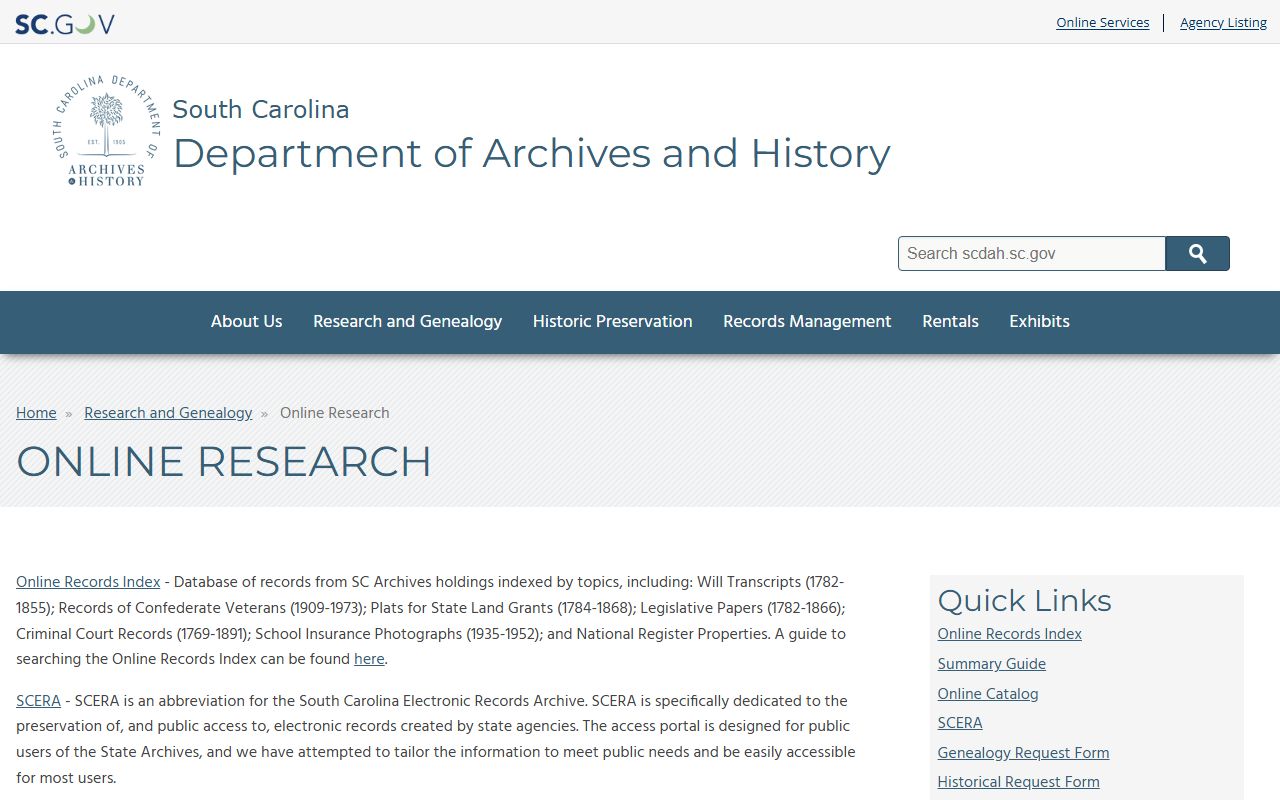
SCDAH's online research portal provides access to digital collections and indexes that cover Clarendon County from its 1855 formation and the parent county records from before that date.
Clarendon County Vital Records for Genealogy
South Carolina required birth and death registration starting January 1, 1915. Under S.C. Code Ann. § 44-63-10, every birth must be registered within five days. The South Carolina Department of Archives and History holds Clarendon County birth records for 1915 to 1918 online and death records for 1915 to 1963. The South Carolina Department of Public Health holds vital records from 1915 to present at 2600 Bull Street, Columbia. Phone: 803-898-3630.
Death certificates become public records 50 years after death under § 44-63-84. The free South Carolina death index for genealogy covers Clarendon County deaths from 1915 through 1967. For Clarendon County genealogy before 1915, church records, census data, and probate files are the primary sources. The county's history as a farming community means that farm census records, such as the agricultural schedules in the federal census, can also help document Clarendon County families in the mid-nineteenth and early twentieth centuries.
Clarendon County Register of Deeds and Land Records
The Clarendon County Register of Deeds maintains land records from 1855 forward. The office is at 411 Sunset Drive, Manning, SC 29102. Phone: (803) 435-4445. Deeds, mortgages, and plats document property ownership across the county's history since its formation. Under Title 30 of the South Carolina Code of Laws, counties are required to maintain and preserve these public land records.
Clarendon County land records are especially useful for genealogy research because the county's agricultural history means that land ownership was central to family identity and economic status. Tracing a family's land from generation to generation often reveals heirs, shows migration patterns, and identifies the community in which an ancestor lived. For land records before 1855, researchers must consult Sumter County records. The SCDAH Online Records Index includes early land grant plats that can help connect families across the 1855 county formation date.
Clarendon County Library and Local Resources
The Clarendon County Public Library at 215 N Brooks Street, Manning, SC 29102 provides local history resources and genealogical materials. Phone: (803) 435-8636. The library holds materials specific to Clarendon County and the surrounding Pee Dee region. Census records, local newspapers, and family history materials available through the library can complement the official county genealogy records held at the courthouse.
The Clarendon County Historical Society preserves local history and may hold genealogical materials specific to the county. The society's collections can be useful when courthouse records have gaps or when you need context about a specific Clarendon County community or family. Clarendon County is also historically significant for the civil rights era, as the Briggs v. Elliott case, one of the cases consolidated into Brown v. Board of Education, originated in Clarendon County.
The South Carolina Historical Society in Charleston at 100 Meeting Street holds statewide manuscript collections that may include materials relevant to Clarendon County families. Phone: (843) 723-3225. The SCGenWeb Archives for Clarendon County provides free volunteer-contributed cemetery transcriptions, census extracts, and family histories.
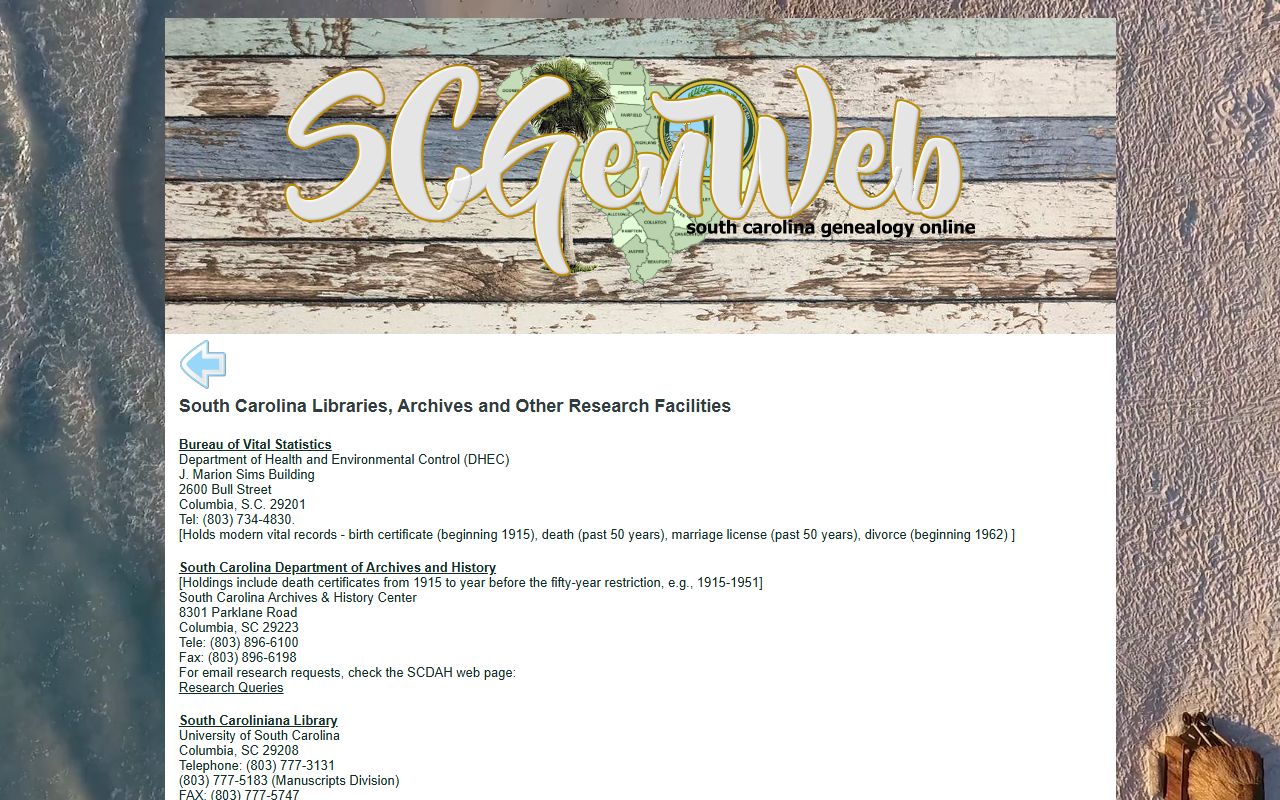
The SCGenWeb project for Clarendon County provides free access to volunteer-indexed records including cemetery transcriptions and census extracts that supplement official county and state genealogy records.
South Carolina Archives Resources for Clarendon County Genealogy
The South Carolina Department of Archives and History holds Clarendon County records including court files, land documents, and census materials. SCDAH is at 8301 Parklane Road, Columbia, SC 29223. Phone: (803) 896-6100. The Research Room provides access to microfilm and a research library covering all 46 counties. Staff answer queries by mail, email, and phone.
The SCDAH Digital Collections include Confederate Pension Applications from 1919 to 1938 and Will Transcripts from 1782 to 1855. Will Transcripts from the Sumter County area before 1855 may include estates from families living in what became Clarendon County. Confederate Pension Applications from 1919 to 1938 include veterans from Clarendon County who applied after the Civil War and Reconstruction.
The Library of Congress South Carolina genealogy guide provides a curated directory of resources covering Clarendon County and all other South Carolina counties. The South Carolina Genealogical Society publishes transcribed records and connects researchers to county-level resources through local chapters.
Cities in Clarendon County
Manning is the county seat of Clarendon County. All county genealogy records are maintained at the Clarendon County courthouse offices on Sunset Drive.
Nearby Counties
Clarendon County borders several South Carolina Pee Dee and Midlands counties. For records before 1855, search Sumter County, which was the primary parent county at Clarendon's formation.